
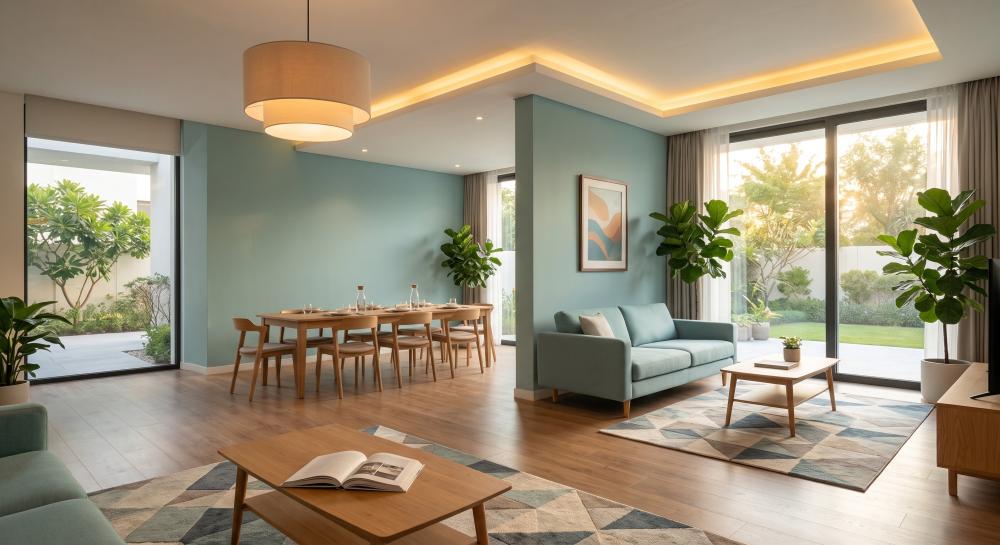
The living room is the heart of the home and one of the most frequently used spaces for welcoming guests, gathering with family, and relaxing. Relying on a single central light source often creates harsh shadows or leaves parts of the room feeling dull and uninviting. The key is to apply the concept of layered lighting, creating both flexibility and visual appeal.
1. Combine the Three Layers of Lighting
To achieve a comfortable and balanced lighting environment, the room should not rely on just one type of lighting:
- Ambient Lighting: Provides the primary illumination for the entire room. It can be achieved through ceiling downlights, a central pendant chandelier, or surface-mounted lights distributed evenly to cover pathways and corners.
- Task Lighting: Designed to provide focused illumination for specific activities without causing eye strain. Examples include a floor lamp next to a reading sofa or a table lamp placed on a side table.
- Accent & Decorative Lighting: Used to highlight architectural and decorative elements, such as concealed LED strips in gypsum-board coves (Cove Lighting), or focused spotlights directed toward wall artwork, wooden wall panels, and bookcases.
2. Choose the Right Color Temperature (Kelvin)
Color temperature has a direct impact on the atmosphere and comfort of the room:
- Warm & Relaxing (2700K–3000K): An excellent choice for living rooms, as warm white lighting creates a cozy, welcoming, and relaxing atmosphere.
- Avoid Very Cool White (Above 4000K): Cool lighting can create a more formal or office-like atmosphere, which may reduce the warm and comfortable feeling of a living space.
3. Distribute Lighting Smartly and Reduce Glare
The distribution of light is often more important than simply increasing its brightness:
- Avoid Direct Light on Screens: Do not position spotlights directly above the TV screen or at an angle that reflects onto the screen, as this can cause distracting glare while watching.
- Illuminate Dark Corners: Placing a floor lamp in an empty or dark corner can make the space feel more spacious while adding visual depth and enhancing the sense of ceiling height.
- Consider the Color Rendering Index (CRI): Choose lighting with a CRI of 80+ or preferably 90+ to ensure that furniture, carpets, wall colors, and decorative elements appear more natural and vibrant.
4. Add Dimmer Switches for Brightness Control
Dimmer switches provide greater flexibility, allowing you to transform the room with a simple adjustment—from a bright and practical environment for family gatherings to a soft, relaxing atmosphere for watching a movie or unwinding at the end of the day.
Dimming can also help reduce energy consumption and provide greater control over the lighting experience, making the living room more comfortable and adaptable to different occasions.